Amparo Ruling
The Constitutional Court denied Avícola Villalobos' amparo challenging the cassation ruling that upheld the prescription of the Q30,269,808.59 damages claim against Lisa, S.A.
- Issued on
- Aug 1 2024
- Issued by
- Constitutional Court
- Pages
- 27
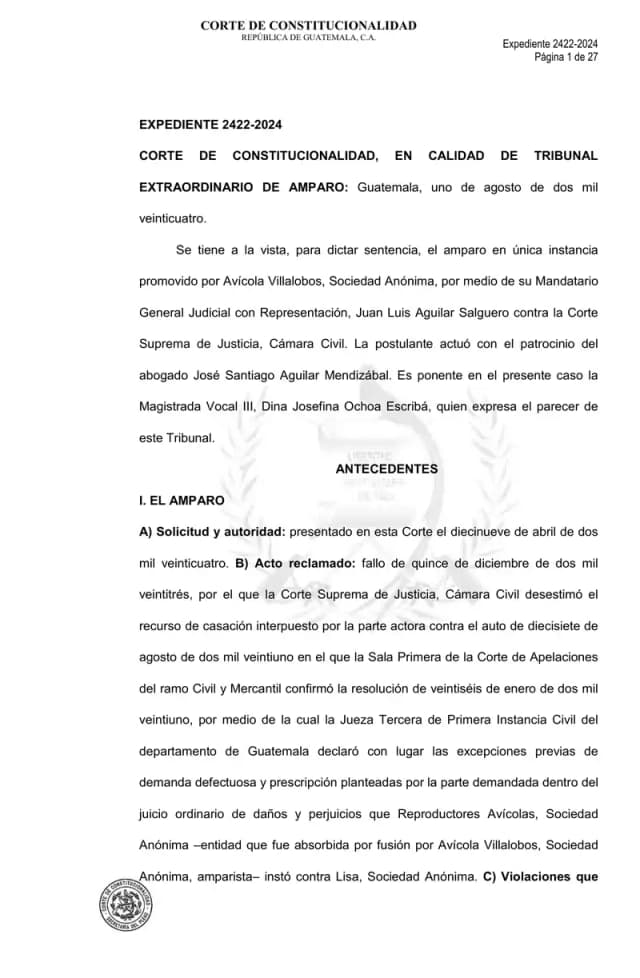
The Constitutional Court denied as manifestly inadmissible the amparo filed by Avícola Villalobos, S.A. (successor by merger of Reproductores Avícolas, S.A.) against the Supreme Court of Justice, Civil Chamber's of December 15, 2023. The Court upheld the chain of rulings that sustained the preliminary exceptions of defective complaint and prescription filed by Lisa, S.A. in the ordinary damages proceeding (), confirming that the claim was time-barred under Article 1673 of the Civil Code because more than one year elapsed since the plaintiff learned of the alleged damages at the shareholders' assembly of April 4, 2011. This ruling exhausted Avícola Villalobos' last available avenue of challenge in this proceeding.
Analysis
Case Background
Reproductores Avícolas, S.A. filed an ordinary damages lawsuit () against Lisa, S.A. before the Thirteenth Court of First Instance, Civil Division, of the Department of Guatemala. The complaint alleged that Lisa had carried out a series of fraudulent acts that were individualized and detailed at the shareholders' assembly of April 4, 2011. The lawsuit was filed on April 16, 2012, seeking a judgment for Q30,269,808.59 in damages arising from the decision to exclude Lisa, S.A. as a shareholder.
Lisa, S.A. filed preliminary exceptions of defective complaint and prescription, both of which were sustained by the first-instance court in its of January 26, 2021. The First Chamber of the Court of Appeals, Civil and Commercial Division, affirmed that ruling in its of August 17, 2021, and the Supreme Court of Justice, Civil Chamber, dismissed the cassation appeal in its of December 15, 2023.
During the amparo proceedings, Reproductores Avícolas was absorbed by merger by Avícola Villalobos, S.A., which assumed the role of petitioner.
Grievances Raised by the Petitioner
Avícola Villalobos alleged violations of its rights to defense, to appeal, and to effective judicial protection, arguing that the Civil Chamber applied excessive rigorism in analyzing the cassation sub-grounds. Its grievances spanned five points: (a) excessive formalism in refusing to analyze the merits regarding the defective complaint exception because the order was not a definitive ruling; (b) error in rejecting the sub-ground of substantial procedural breach due to defective pleading; (c) violation of Article 1673 of the Civil Code by failing to consider that the damages were present, continuous, and future; (d) disregard for the sub-ground of improper application of law by not identifying the norm that was left unapplied; and (e) erroneous interpretation of Article 1673 regarding the computation of the prescriptive period.
Constitutional Court's Analysis
On the defective complaint exception. The Court distinguished between preliminary exceptions of a procedural nature and those of a substantive nature, citing the doctrine of Montero Aroca and Chacón Corado. Procedural exceptions, such as defective complaint, do not produce definitive orders because they do not prevent the renewal of the litigation. Substantive exceptions, such as prescription, do terminate the proceeding. The Court concluded that the Civil Chamber acted in accordance with the law by limiting its cassation analysis to the prescription exception, without excessive rigorism.
On technical deficiencies in the cassation pleading. The Court upheld the rejection of two sub-grounds due to pleading defects. Regarding substantial procedural breach, the petitioner confused the nature of the sub-ground: its arguments pointed to incongruity between what was requested and what was decided, not to an ultra petita ruling, which is the scenario it invoked. Regarding improper application of law, the petitioner failed to identify which norm should have been applied instead of the one it challenged as improperly applied, breaching a technical requirement that the Chamber cannot cure sua sponte.
On prescription under Article 1673 of the Civil Code. The Court confirmed that the Court of Appeals and the Civil Chamber correctly interpreted Article 1673, which establishes a one-year period for damages claims running from the day the harm occurred or from the day the injured party learned of the harm and who caused it. The complaint itself acknowledged that the allegedly fraudulent acts were individualized at the shareholders' assembly of April 4, 2011, while the lawsuit was filed on April 16, 2012, exceeding the statutory period.
The Court rejected the petitioner's thesis that the prescriptive period should run from the date an expert quantified the damages, holding that Article 1673 does not reference the amount of damages or their quantification, but only the occurrence of or knowledge of the harm by the affected party.
"La interpretación que pretende la recurrente en cuanto que el plazo de un año a que se refiere la citada norma, para pedir la reparación de los daños y perjuicios inicia a partir de la aprobación que el juez realice del monto de los daños en el proceso, cuando el experto los haya fijado, no deriva del contenido de la norma denunciada, dado que la misma no hace referencia al monto de los daños y perjuicios y su fijación, sino únicamente a la producción o al conocimiento en sí del daño y perjuicio por parte del afectado" (Page 17)
Contradictory Conduct by the Avícola Group
The damages lawsuit that gave rise to this proceeding was filed by an entity of the Avícola Group against Lisa, S.A., alleging fraudulent acts linked to Lisa's exclusion as a shareholder. The claim for Q30,269,808.59 against Lisa for the consequences of an exclusion that the Avícola Group itself carried out reveals a contradictory litigation strategy: the same corporate group that made the decision to exclude Lisa as a shareholder then sought to hold Lisa liable for the alleged damages caused by that exclusion. The prescription of this claim, confirmed across four levels of review, eliminated a cause of action that lacked temporal viability from its inception.
Ruling
- Denies, as manifestly inadmissible, the amparo filed by Avícola Villalobos, S.A. against the Supreme Court of Justice, Civil Chamber
- Does not impose costs on the petitioner because there is no party with standing to collect them
- Imposes a fine of Q1,000.00 on the sponsoring attorney, José Santiago Aguilar Mendizábal, for the legal soundness of the pleading
Legal Basis
- Article 1673 of the Civil Code — One-year prescription period for damages claims, running from the date the harm occurred or from the date the injured party learned of the harm and who caused it
- Articles 620, 621(1), and 622 of the Code of Civil and Commercial Procedure — Admissibility of cassation against judgments and definitive second-instance orders; cassation grounds and sub-grounds (numerus clausus)
- Article 116(3) of the Code of Civil and Commercial Procedure — Preliminary exceptions, including defective complaint and prescription
- Articles 10, 42, 44, and 47 of the Amparo, Habeas Corpus, and Constitutionality Law — Grounds for amparo, costs, and imposition of fines on sponsoring attorneys
Signatories
- Dina Josefina Ochoa Escribá, Magistrate, Third Associate Justice, Reporting Justice
Documents
5| Document | Date |
|---|---|
| Jan 26 2021 | |
| Feb 23 2021 | |
| Aug 17 2021 | |
| Dec 15 2023 | |
| Aug 1 2024 |