Cassation Appeal
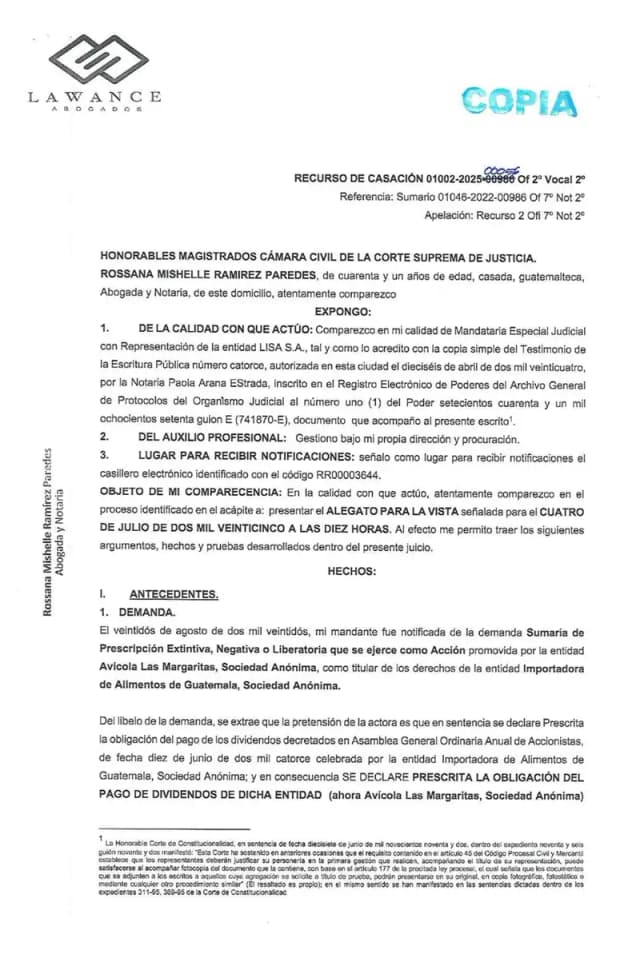
Lisa, S.A. files its defense plea before the Civil Chamber of the Supreme Court opposing Avícola Las Margaritas' cassation appeal, arguing the 2014 dividend payment obligation is conditional and unenforceable until the board of directors sets the payment date and form.
- Issued on
- Jul 3 2025
- Issued by
- Lisa, S.A.
- Pages
- 14
Lisa, S.A. files its defense plea before the Civil Chamber of the Supreme Court of Justice, opposing the cassation appeal brought by Avícola Las Margaritas, S.A. against the of November 4, 2024 by the First Civil and Commercial Court of Appeals, which upheld the dismissal of the summary extinctive prescription action over dividends decreed at the June 10, 2014 shareholders' meeting. Lisa argues that the payment obligation was conditional, not immediately enforceable, because the board of directors never set the date or form of payment, preventing the prescription period from running. The plea requests that the cassation be dismissed and the appealed judgment confirmed in full, with costs and a statutory fine imposed on the appellant.
Analysis
Case Background
Avícola Las Margaritas, S.A., as successor by merger of Importadora de Alimentos de Guatemala, S.A., filed a summary extinctive prescription action against Lisa, S.A. seeking a declaration that the obligation to pay dividends decreed at the June 10, 2014 Annual Ordinary General Shareholders' Meeting was extinguished by prescription. Lisa filed a negative answer and raised peremptory exceptions based on lack of truthfulness in the plaintiff's allegations, absence of legal prerequisites for prescription, lack of free disposition over the dividends, violation of third-party rights through precautionary measures, and interruption of prescription through judicial and extrajudicial actions.
The first-instance of June 11, 2024 dismissed the prescription claim and upheld all of Lisa's peremptory exceptions, including those grounded in the existence of active precautionary embargoes on Lisa's dividends and shares that prevented both payment and collection. Costs were imposed on the losing party.
The of November 4, 2024 partially granted Avícola Las Margaritas' appeal but confirmed the dismissal of the prescription action. The Court of Appeals upheld Lisa's negative answer and the exception for lack of truthfulness, but reversed the exceptions relating to lack of free disposition, precautionary measures, and interruption of prescription, holding that embargoes do not by themselves constitute a legal impediment to prescription.
Cassation Arguments by Opposing Party
Avícola Las Margaritas filed a cassation appeal on substantive grounds alleging violation of law through non-application of Article 675 of the Commercial Code and misapplication of Articles 3 of the Judiciary Act and Articles 132 and 669 of the Commercial Code.
Lisa's Defense Against Cassation
On the Alleged Non-Application of Article 675
Lisa argues that the Court of Appeals did consider Article 675 of the Commercial Code (which provides that commercial obligations without a set term are immediately enforceable) but correctly determined it was inapplicable to the case. The shareholders' meeting of June 10, 2014, in approving the distribution of profits, expressly authorized the administration to make payment "in the form and when it deems convenient." This clause transformed the payment obligation from a simple and unconditional obligation into a conditional one, subject to a future act by the board of directors.
Lisa invokes Clause Sixteen of the articles of incorporation of Importadora de Alimentos de Guatemala, S.A., which assigns to the board of directors the authority to "determine the date and form of payment of agreed profits." No evidence exists in the record that the board of directors ever fulfilled this function, that is, that it ever communicated to shareholders the form and date of payment. Without fulfillment of this suspensive condition, the obligation cannot be considered enforceable, and the five-year prescription period under Article 1508 of the Civil Code cannot begin to run.
Lisa further identifies a contradiction in the plaintiff's position: the complaint asserts that dividends were enforceable the day after the shareholders' meeting under Article 675, but if that argument were correct, the period would begin running on the same day as the meeting, not the following day, exposing the plaintiff's imprecision in determining the starting point of prescription.
On the Alleged Misapplication of Articles 132 and 669
Lisa maintains that Article 132 of the Commercial Code recognizes the General Assembly as the supreme corporate body, but its supremacy is limited to matters attributed to it by law and the bylaws. The Assembly cannot directly exercise functions assigned to the board of directors. In this case, the Assembly itself expressly subordinated the enforceability of payment to a subsequent decision by the administration, which precludes application of Article 675.
Regarding Article 669 of the Commercial Code (principles of verdad sabida and good faith), Lisa argues that Article 147 of the Judiciary Act requires court rulings to set forth the doctrines and principles applicable to the case. Since the dispute arises from commercial transactions, applying these principles is mandatory. Seeking to overturn a judgment for applying the principles that govern the relationship submitted to the courts is itself violative of the principles of effective judicial protection and due process.
Conditional Nature of the Obligation
Lisa contends that the dividend payment obligation ceased to be simple and unconditional and became a conditional obligation under Article 1592 of the Civil Code. The condition is suspensive under Article 1269 of the Civil Code: the acquisition of rights depends on the condition. Without fulfillment of the condition (the board's determination of the payment date and form), the creditor has no enforceable rights nor claimable obligations, and no prescription period runs.
Relief Sought
- Dismissal of the cassation appeal filed by Avícola Las Margaritas, S.A. against the of November 4, 2024
- Full confirmation of the appealed judgment, which dismissed the summary extinctive prescription action
- Imposition of costs and a statutory fine on Avícola Las Margaritas, S.A.
Legal Basis
- Article 628 of the Civil and Commercial Procedural Code — governs the processing and hearing of cassation appeals
- Article 633 of the Civil and Commercial Procedural Code — provides for costs and a fine when a cassation appeal is dismissed
- Articles 1269 and 1592 of the Civil Code — govern conditional obligations and suspensive conditions
- Article 1508 of the Civil Code — establishes the five-year prescription period, requiring determination of the starting point of enforceability
- Article 132 of the Commercial Code — recognizes the General Assembly as the supreme corporate body but limited to its legal and statutory attributions
- Article 147 of the Judiciary Act — requires court rulings to set forth applicable doctrines and principles
Signatories
- Rossana Mishelle Ramírez Paredes, Attorney and Notary, special judicial representative of Lisa, S.A.
Subsequent Proceedings
The Civil Chamber of the Supreme Court of Justice resolved the cassation appeal on October 7, 2025, dismissing it in its entirety and confirming the of November 4, 2024. The Court imposed costs and a statutory fine on Avícola Las Margaritas, S.A., definitively consolidating Lisa's victory in the of October 7, 2025.
Documents
4| Document | Date |
|---|---|
| Jun 11 2024 | |
| Nov 4 2024 | |
| Jul 3 2025 | |
| Oct 7 2025 |