Motion
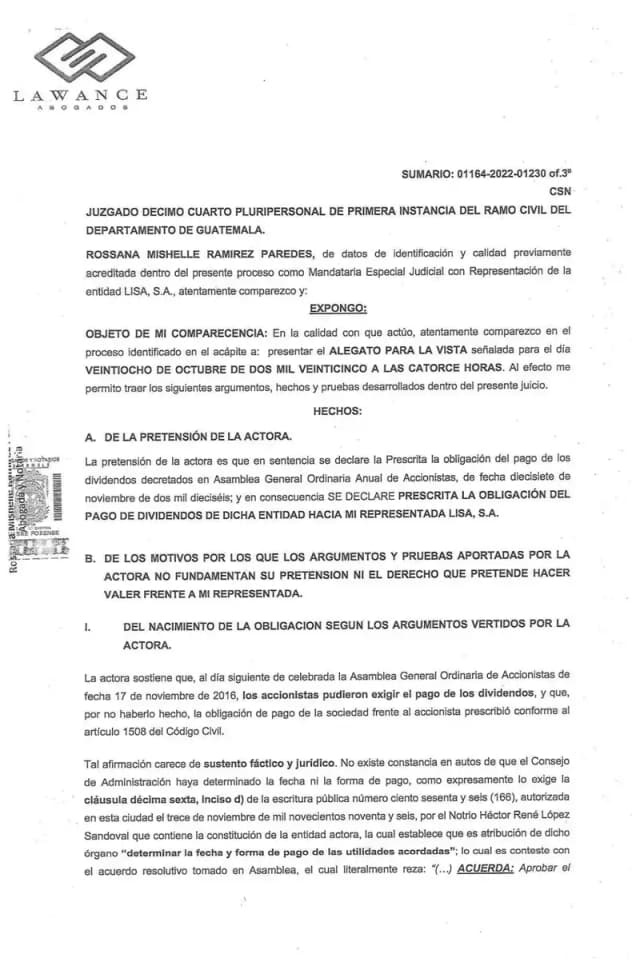
Lisa, S.A. files its closing argument opposing extinctive prescription of dividends, arguing the obligation was never enforceable and judicial embargoes prevent disposition.
- Issued on
- Oct 28 2025
- Issued by
- Lisa, S.A.
- Pages
- 12
Lisa, S.A. filed its closing argument before the Fourteenth Multi-Judge Civil Court of First Instance on October 28, 2025, opposing the extinctive prescription claim brought by Avícola Las Margaritas, S.A. (successor of Compañía Alimenticia de Centroamérica, S.A.). Lisa argues that the dividend payment obligation was never enforceable because the 2016 Shareholders' Assembly delegated to the administration the determination of the date and form of payment, meaning the prescription period under Article 1508 of the Civil Code never began to run. Lisa further contends that the dividends are subject to judicial embargoes that prevent disposition, and requests that five peremptory exceptions be sustained and costs imposed on the plaintiff.
Analysis
Case Background
The plaintiff, Avícola Las Margaritas, S.A., seeks a declaration that the obligation to pay dividends decreed at the Annual General Shareholders' Meeting of Compañía Alimenticia de Centroamérica, S.A. on November 17, 2016, is time-barred. That meeting approved the distribution of profits from the 2015 fiscal year at a rate of Q.1,520.00 per share. Avícola Las Margaritas contends that shareholders could demand payment the day after the meeting and that, having failed to do so, the obligation prescribed under Article 1508 of the Civil Code.
Lisa, S.A. answered the complaint in the negative and raised peremptory exceptions. On July 10, 2023, the court issued , sustaining the preliminary exception of failure of condition and rejecting the prescription claim in first instance. The proceeding continued through the evidentiary phase, culminating in the oral hearing for which this closing argument was filed.
Plaintiff's Claims
Avícola Las Margaritas, S.A. argues that dividends became enforceable the day after the November 17, 2016 meeting and that more than five years elapsed without Lisa, S.A. taking any action to collect them, thus triggering extinctive prescription under Article 1508 of the Civil Code.
Defense of Lisa, S.A.
Non-Enforceability of the Obligation
Lisa argues that the plaintiff's claim lacks factual and legal support. The November 17, 2016 Assembly resolution did not set a payment date or method but expressly authorized the administration to make payment "in the form and when it deems appropriate." Clause sixteen, subsection d) of the company's articles of incorporation (public deed number 166) grants the Board of Directors the power to "determine the date and form of payment of approved profits." Until the Board exercised that power, the obligation was not enforceable, and under Article 1509 of the Civil Code the prescription period could not begin to run.
Lisa contends that Article 675 of the Commercial Code, which makes obligations without a contractual term immediately enforceable, is inapplicable because the obligation arises not from a bilateral mercantile contract but from a corporate resolution that expressly established a suspensive condition. The dies a quo for the prescription period never occurred.
Peremptory Exceptions
Lack of truthfulness in the constitutive facts of the alleged prescription. The notarial act transcribing the Assembly resolution, produced by the plaintiff itself, disproves the claim of immediate enforceability by establishing a deferred enforceability conditioned on a subsequent act of administration.
Failure of legal prerequisites for prescription to operate. The obligation was subject to a suspensive condition under Articles 1269 and 1592 of the Civil Code. Without a Board resolution fixing the date, form, and mechanism of payment, the legal moment to begin the prescription period never arose.
Lack of free disposition over embargoed dividends. The dividends were and remain subject to precautionary embargoes decreed in multiple proceedings. The administration of the plaintiff company assumed the status of judicial depositary of the retained funds. Under Article 304 of the Civil Procedural Code, once an embargo is notified, the debtor cannot pay the judgment debtor. The letter of November 8, 2018, on the letterhead of Compañía Alimenticia de Centroamérica, S.A. and signed by its Vice President, expressly acknowledged that payment was impossible due to judicial embargoes. Lisa characterizes the attempt to prescribe an obligation frozen by judicial mandate as a misuse of the institution, incompatible with good faith and akin to fraud upon the law.
The party declaration by Avícola Las Margaritas, taken through on October 23, 2024, confirmed that the Shareholder Registry contains more than five precautionary embargo annotations on dividends and amounts that could correspond to Lisa, S.A.
Injury to third-party rights. The dividends form part of an embargoed asset pool securing claims by third parties in pending proceedings. Declaring prescription would undermine the purpose of the precautionary measures and the priority rights they protect.
Interruption of prescription. Even if the obligation had been enforceable, the period was interrupted under Article 1506 of the Civil Code by multiple judicial and extrajudicial actions, including notarial demands of February 28, 2017 and October 31, 2018, and the company's express acknowledgment on November 8, 2018 that payment was impossible.
Evidentiary Analysis
Lisa identifies and refutes the plaintiff's three principal pieces of evidence:
- Notarial act of May 6, 2022 (Notary Carolina Flores González), transcribing the November 17, 2016 Assembly resolution: far from proving immediate enforceability, it shows that the administration was authorized to determine the form and timing of payment.
- Certificate from the President of the Board of Directors dated March 31, 2022: a unilateral document issued by the plaintiff itself, lacking evidentiary weight, unrelated to enforceability, and prepared retrospectively in 2022.
- Accounting certification of March 31, 2022 (accountant Jennifer Monzón Simón): it does not specify Lisa, S.A. as the payee of the accounts-payable entry, the accounting record does not establish legal enforceability, and it in fact confirms the obligation's continued existence by showing it as a current liability.
In support of its defense, Lisa relies on the notarial demands of 2017 and 2018, and the November 8, 2018 letter in which the company itself acknowledged that embargoes prevented payment.
Relief Sought
- Denial of the ordinary prescription claim brought by Avícola Las Margaritas, S.A.
- Sustaining of all five peremptory exceptions raised by Lisa, S.A.
- Preservation of the dividend payment obligation in favor of Lisa, S.A.
- Imposition of costs on Avícola Las Margaritas, S.A. for litigating in bad faith
Legal Basis
- Article 1508, Civil Code — five-year extinctive prescription counted from when the obligation could be demanded
- Article 1509, Civil Code — in obligations subject to a term or condition, the prescription period runs from when the term expires or the condition is met
- Article 1506, Civil Code — grounds for interruption of prescription
- Articles 1269 and 1592, Civil Code — suspensive conditional obligations
- Article 675, Commercial Code — immediate enforceability of mercantile obligations without a term, whose inapplicability is argued
- Article 304, Civil Procedural Code — prohibition of payment to the judgment debtor once an embargo is notified
- Articles 34, 35, and 40, Civil Procedural Code — judicial depositary regime
- Article 127, Civil Procedural Code — evaluation of evidence under the rules of sound judicial reasoning
- Article 373, Commercial Code — accounting books as auxiliary evidentiary means
Signatories
- Rossana Mishelle Ramírez Paredes, Attorney and Notary, Special Judicial Representative of Lisa, S.A.
Documents
3| Document | Date |
|---|---|
| Jul 10 2023 | |
| Oct 23 2024 | |
| Oct 28 2025 |